Gasping for Air? Why Your First Mile Is So Hard
The 13-Year Mystery
I had a running injury that kept me from running consistently for the better part of 13 years. I went to running coach after running coach, chiropractors, PT specialists, orthopedists, and they all told me the same thing after treatment: “I can’t fix you.” It was an incredibly frustrating experience because I so badly wanted to get back to running, but I wasn’t able to. And specialist after specialist told me to do nearly the exact same things, and it didn’t work.
At some point, after the third or fourth specialist that I saw, my brain started to think, “Wait, this doesn’t make sense, I’ve already done this and it didn’t help.” I didn’t listen to that voice though. After all, these people made their livings fixing athletes, and surely they knew better than me, so I kept looking for another, and another, each time hearing the same thing, “I can’t fix you.”
I should’ve listened to that voice earlier, it would’ve saved me years of rehab. But I didn’t, because they were the experts and I was just a guy trying to get back on the road. I assumed that, because they were the “experts” their abilities to identify the issue was superior to mine, and perhaps I was doing something wrong and my logic was somehow flawed.
As it turns out, I wasn’t wrong, my logic wasn’t flawed. And as I was wondering about why we lose our breath at the early portions of a run when we’re first starting out, I got that same feeling. The explanation that I kept reading didn’t make sense given my history (and I started, stopped and restarted again many times during that 13-year period). Something seemed “off” in what I read time and time again and that same twinge of “Wait, this doesn’t make sense,” crept into the back of my brain.
What we read most often is that it’s because our bodies are shifting from a resting state to one of high demand, and that creates an oxygen debt. And the heart and lungs need to adjust to this demand before things can stabilize. But that didn’t make sense to me.
When we’re starting a running program, our bodies aren’t yet in a position to fully stabilize things, our bodies haven’t yet adapted to the demands of running so we simply don’t have the ability to process oxygen on a higher level, but that’s what we read, time and time again. It’s like telling someone who’s building up credit card debt not to worry, because things will stabilize eventually if they keep doing what they’re doing, without changing their spending habits. It doesn’t make sense.
The Jack Daniels “Aha!” Moment
Then, I remember reading a book by running coach Jack Daniels, Daniels’ Running Formula, who makes the argument that breathing is more about getting rid of carbon dioxide than it is bringing in fresh air. And then it clicked.
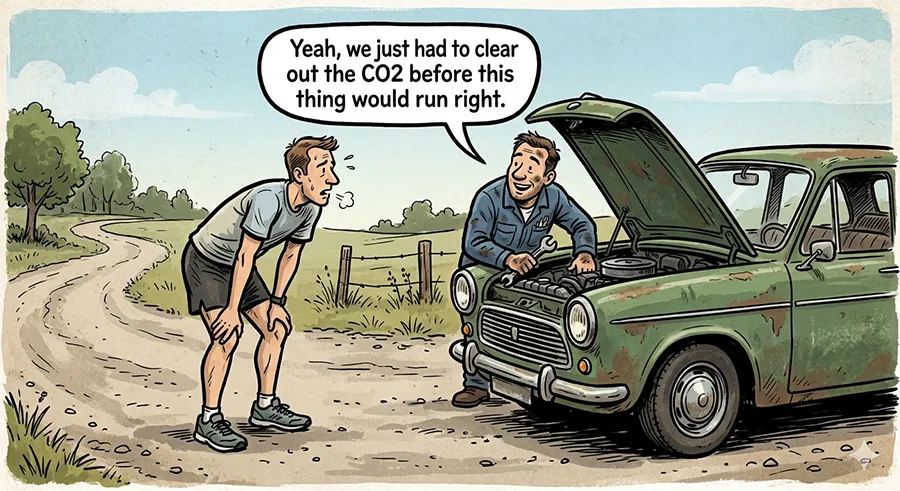
Again, if lack of oxygen was the only issue, then it would mean that our bodies would need to reach a state of efficiency that, frankly, doesn’t seem plausible to me. But, if it was too much of something else, in this case carbon dioxide, then the body needing a little time to get rid of it then causing us to breathe harder for a few minutes makes perfect sense.
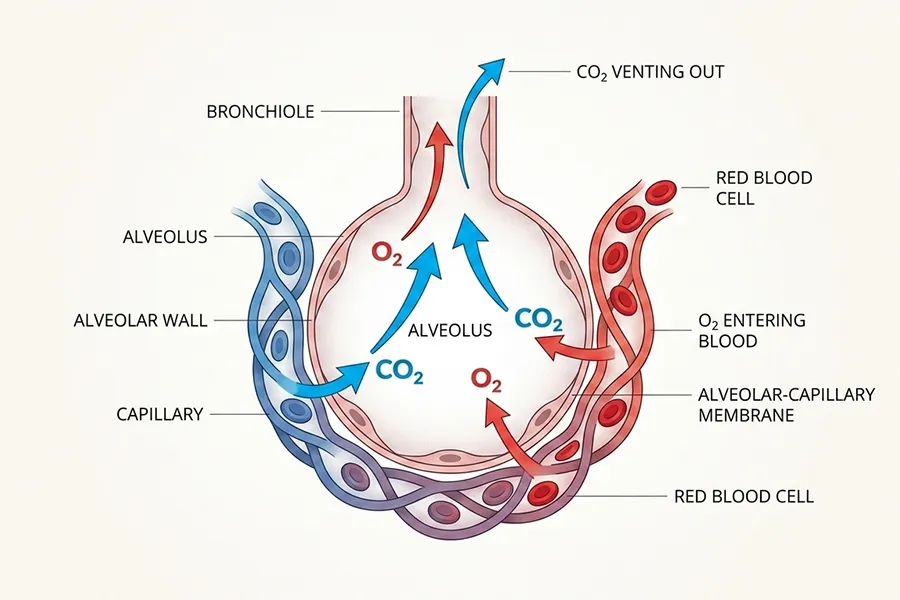
As it turns out, the brain is at least slightly more sensitive to carbon dioxide than it is oxygen and, as Daniels argued, our breathing is more regulated by increasing carbon dioxide levels than it is decreasing oxygen levels.
Why Your Brain is a CO2 Sensor
One of the illustrations (paraphrased) that Daniels gives is to remember a time that you were holding your breath under water. At some point, we get an urge to come up to the surface and breath — the longer we stay down, the more that urge becomes urgent. That urgency that we feel, is more about the body saying, “We’ve got way too much CO2 here, I need to clear this out before things get serious!”.
And several studies back this up.
How to Handle the “First-Mile Gasp”
So what should you do when you start breathing heavy at the beginning of a run? Keep going, walk if you need to. Understand that your body just suddenly started requiring a lot of energy, and a byproduct of that is carbon dioxide. And that carbon dioxide has built up and needs to leave. That process of getting rid of it will happen relatively quickly, so keep moving and let it run its course.
The good news here is that, the longer we run consistently, the better our bodies become at running and the more efficiently our bodies will clear that CO2 — you’ll no longer be gasping for air a minute after you start running. This can happen in a few weeks, a few months or longer for some people. But it does improve significantly.
Just know though that those heavy breaths? They’re completely normal, nothing’s wrong. It’s a rite of passage, a badge of honor, if you will, that every runner earns once they get through this stage. Keep moving though, whatever that looks like for you. Keep lacing up, heading out and get through this stage. You probably won’t even notice that those rough starts to your runs aren’t there anymore. But one day, you’ll finish a run and think, “Wow, that was easy!”. And then it hits you.
Sources:
- Physiology, Respiratory Drive – National Center for Biotechnology Information (NCBI). An in-depth look at how the body prioritizes CO2 levels to regulate breathing.
- How the Brain Controls Breathing in Response to O2/CO2 Blood Levels – Respiratory Therapy. A breakdown of the chemical sensors that trigger the “gasping” reflex.
- Daniels’ Running Formula by Jack Daniels, PhD – The foundational text for modern running science, including the theories on breathing rhythms and ventilation.