180 Steps Per Minute: Does Running Science Agree?
Running is supposed to reduce stress. Personally, I’m busy. I have a never ending stream of tasks waiting for me every time I open my laptop, people to get back to and an office that has an ongoing design style that I can only describe as “Midcentury Dumpster.” Running is the place where I leave all of that behind.
But then I jump on the internet and see a list of things that just complicate running — I need to be at 180 steps per minute; stay in zone 2 at least 80% of the time; elbows bent at 90 degree angles; run tall; etc… Whatever happened to just getting out and running, letting the brain drift while I drop off into my own little world?
For me, the biggest thing is the 180 step rule. I tend to stride at what I thought was a pretty quick pace, turns out it’s not though, it’s below that magic number, though not by a lot. I’ve tried to ramp up my cadence but I can’t seem to get there. So I dismissed it and kept running.
But me being me, it continued to gnaw at me, I kept wondering if I was doing something wrong. So I started digging into the question.
The Origin of the 180-Step Rule: Coach Jack Daniels
Renowned running coach Jack Daniels wrote a book that was published in 1998 called “The Daniels Running Formula”. His book takes an incredibly detailed look at just about everything related to competitive running. And in this book, he writes, ”We often talk about getting into a good running rhythm, and the one you want to get into is one that involves 180 steps or more per minute.”
And that’s the quote that, as far as I can tell, started all of this.
His mindset when talking about that 180 steps per minute was one of injury prevention; of keeping his runners running and not sidelined with injuries. The idea is that, the higher the cadence, the shorter our strides, and the shorter our strides, the less the impact running has on our bodies.
He arrived at this number from observation, the most referenced being when he and his wife counted the steps of Olympic runners in the 1984 Los Angeles Olympics. But he wasn’t just an observer, he coached runners in multiple Olympics and had a pretty respectable level of success at multiple colleges, even being named NCAA Division III Women’s Cross Country Coach of the Century in the year 2000. Suffice to say he was no slouch.
Understand also that Daniels started coaching in 1961, a time when running science wasn’t nearly as advanced as it is today. His concepts, though, are still very much used by running coaches today. And though he did spend time in labs, you’d just as likely see him sitting on the hood of a car holding testing apparatuses as vehicles paced his runners to gather real-world data.
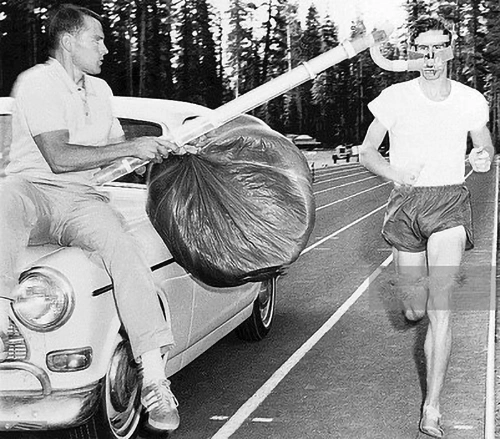
Coach Jack Daniels gathering real-world data the old-fashioned way.
That said, a lot of people in lab coats have studied running cadence since his book’s publication.
What Modern Running Science Says About Cadence
Science being science, it doesn’t approach the question with just a simple “What’s the ideal cadence for runners.” It breaks it down into separate units, different aspects of running.
For example, studies have looked at how increasing cadence reduces stress on the body, what part of the body that stress hits, and more interestingly to me at least, how the joints of different runners handle that stress.
It’s become a fairly detailed science and, though there’s not an official stride rate recommendation, we have discovered things like increasing stride rates by 5-10% can significantly protect against the stress put on our bodies by running and that the joints in different runners handle stress differently— all runners are not built the same.
Part of the mechanics of running is that, as we’re moving forward, we spend a small amount of time in the air. How we land and the impact of that landing is where problems pop up. Consider that, when our forefoot hits the ground, there’s a braking sensation that the body feels, and that reverberates through our feet, ankles, hips and back; all the way up. Shortening our stride reduces that stress, thereby making running easier on our bodies — that’s exactly the point that Daniels was making. And science supports this, but with a bit of nuance.
Why One Size Doesn’t Fit All: Bio-Mechanics and Comfort
For example, a runner that’s, say, 6’3” tall with long legs is likely going to settle into a different cadence than someone who’s 5’2” with short legs. And different bodies distribute and absorb the stresses of running differently, which are just a few reasons why a single cadence doesn’t work perfectly for everyone.
Interestingly, another thing kept popping up in the research studies that caught my attention: the idea of self-selected cadence.
For years, I was of the opinion that, left to its own devices, a runner’s body would naturally fall into its most efficient stride given enough miles on the legs. Granted, there may be a lot of shin splints getting to that stride, but it would eventually happen.
What the data suggests is that we do eventually settle into a stride that feels comfortable and is efficient, but that doesn’t mean that our comfortable stride rate is one that’s ideal for injury prevention. In other words, the stride that initially feels most right for us and the one that’s best isn’t always the same thing.
Personally, I used to run right around 156 steps per minute, and I was constantly dealing with shin splints to some degree. When I intentionally upped my cadence, those recurring injuries disappeared.
Honestly, when I started digging into writing this, I wanted this number of 180 steps a minute to be wrong. I’m a contrarian by nature and I hate being told what to do. The more I looked at things though, the more I came around to, “You know, that’s probably not a bad idea.” And I don’t think that it is.
Finding Your Magic Number (Even if it’s Not 180)
Obviously, as runners, we’re all different and there isn’t a “one size fits all” number. Personally, I’m pretty consistently at a cadence of 173, which seems to work for me. I’m 5’7” and my running issues at this point have zero to do with how hard my foot lands. And, keep in mind that even Daniels himself never said that 180 was the gold standard, he said, “180 steps per minute *or more*.”
So, for the time being, I’m just going to run. And honestly, I don’t know how I can speed my cadence up any more without fundamentally changing the entirety of my stride, and it’s one that I’ve spent a lot of time working on because yes, I obsess about things like that. But my arms will never stay at a perfect 90 degrees, zone 2 is often ignored and it’s literally impossible for me to “run tall”, I’m only 5’7”!
Keep moving.
Sources & Further Reading
- Effects of Step Rate Manipulation on Joint Mechanics during Running – A detailed look at how increasing your cadence by 5% to 10% reduces the impact loading and stress placed on the hips and knees. (via PubMed Central)
- The Influence of Running Cadence on Biomechanics and Injury Prevention: A Systematic Review – A comprehensive review analyzing how stride adjustments manipulate loading rates and play a critical role in preventing common overuse injuries. (via PubMed Central)
- Jack Daniels on Cadence – An archival overview detailing Coach Jack Daniels’ original observations on stride rates and his philosophy on running rhythm. (via The Body Mechanic)
- Step frequency patterns of elite ultramarathon runners during a 100-km road race – Real-world data observing how elite endurance athletes naturally select and modify their step frequencies across massive distances. (via Journal of Applied Physiology)