

The 17-Start Struggle
I had a running injury that kept me off the road for the better part of 13 years. Looking at my running logs, I started the Couch to 5k program 17 times during that period, which is pretty humbling when my brain was used to busting out a 15mi run every Friday. Suffice to say, I know a thing or two about starting again and have asked that question “When does running get easier? (Again)” more times than I’d like to think.
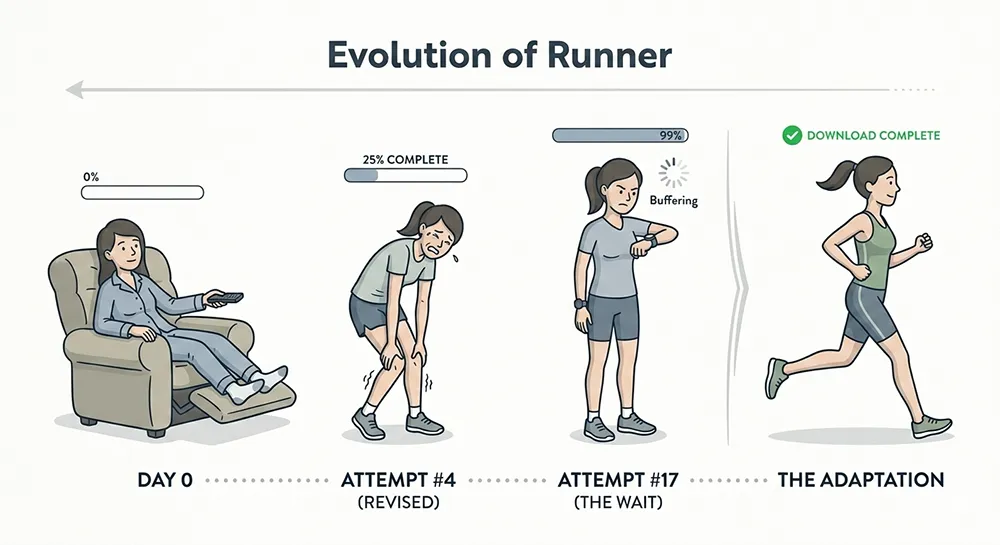
I never researched the why though. At that point, I was far more concerned with being able to run 2 miles without my glutes and back feeling like I had sciatica, or having a searing pain in my left hip than studying mitochondria and capillary adaptations. I just wanted to run.
If you’re reading this, you know what it feels like when your lungs can’t seem to grab enough air less than a quarter mile into your run; you know that feeling of fatigue that comes on and takes hold for the duration of your run; having just a few tenths of a mile to go and thinking, “I really want to walk now”, but mentally wanting to push through anyway. I get it, I’ve been there, many times.
And this begs the question: when does running become easier? In short, it depends on a lot of factors. Things like age, weight, consistency, length and intensity of your runs, what your body was used to before you started running and more. All of those matter when it comes to how long it will take for your body to adapt to running, for when running will become “easier”.
And I used that word, “adapt”, because that’s the name of the game: adaptation. So let’s talk about those adaptations.
The Key: Adaptation
If you do a quick search on the internet, perhaps you already have, you’ll read the typical AI answer about capillary growth and changes to mitochondria. These are important and very real, but it leaves out one key thing: the heart.
Before moving on though, I think it’s worth noting that all the science in the world isn’t going to matter one bit if our runs don’t feel any different. We can read about how this and that are improving in our bodies but, 6 months in, if running doesn’t feel any different, what do we do then? I may have an answer for that, and it’s something that a lot of us may not consider when asking ourselves this question but we’ll come back to that. Let’s dig into what’s happening inside of our bodies when we start a running program.
The first thing that happens to make running feel easier involves the heart. To put it simply, our stroke volume increases. But what does that actually mean and why does it matter?
When we start a running program, we hit a point early in our runs when we start “gasping for air”, our breathing gets heavy and it feels very much like we’re having trouble taking in enough air. What’s happening is that we’ve very suddenly increased our need for blood flow — notice I didn’t say oxygen. That would be way too simple and, well, wrong.
Along with our need for oxygen, we also need to clear out things like carbon dioxide and (those things that makes us feel like we can’t catch our breath, our legs burn, the feeling that we need to stop, etc….).
When you’re starting a run and it feels like you can’t grab enough air, it’s not a lack of oxygen; it’s the body’s ability to get the waste out—your “pump” hasn’t upgraded yet.
Part 1: The Heart Gets an Upgrade
The heart is essentially just a pump; it’s a tool that the brain has at its disposal to regulate things in the body. And the more we exercise, the better that tool becomes; its ability to deliver more blood per beat improves (otherwise known as stroke volume.) So, as our heart develops, it doesn’t need to work as hard to clear things out in the beginning and throughout our runs and keep a steady stream of oxygen flowing. And, the more we run, the stronger the heart gets, and the better it’s able to deliver oxygen and clear out the bad stuff, resulting in runs that are much more comfortable.
That’s only the first adaptation that comes online though. And, with this alone, you still won’t experience that near-effortless feeling that you’re after. Not to worry though, there are a few more things happening that will arrive at that pinnacle.
Let’s talk about mitochondria.
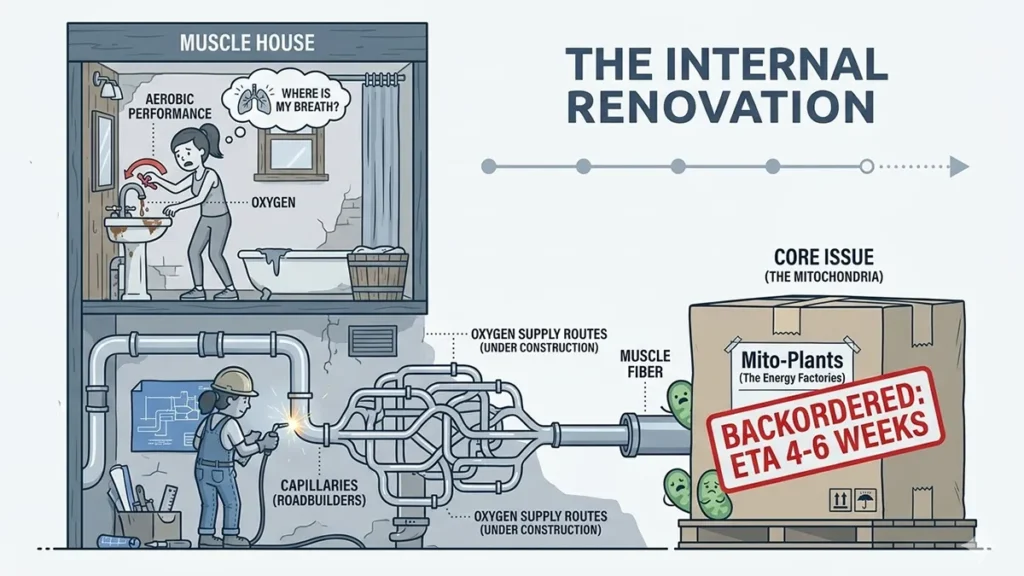
Part 2: Cleaner And More Sustainable Energy (Mitochondria)
Any time our muscles need energy, they use and energy source called ATP and our body’s ability to “cleanly” manufacture ATP is largely dictated by the amount of work that our muscles have been doing — if we sit around after work or school and binge Paramount shows, have daily TikTok marathons or spend endless hours on Xbox, our body’s ability to produce ATP will reflect that demand.
Once we start running though, the demands change — we need more energy, and we need it now.
At first, the muscles will grab all available ATP and use that, but that may only get us through our first few steps, if that, literally. But the body is always making energy and, one way or another, it will meet current demand.
Our body’s most efficient way of making ATP is through the use of mitochondria, tiny “organelles”, which is a fancy way of saying that they’re small organ-like things (think the liver, heart, lungs, etc….) that live inside of most of the cells in the body. Mitochondria-manufactured ATP uses a process and ingredients that tends to produce less waste, the main ingredient being oxygen. Again, it’s a highly efficient and effective process but, when we start a running program, there’s a problem.
The number of mitochondria in our bodies has been determined by what we’ve been doing (maybe those shows on Paramount, TikTok sessions or Xbox?) so that highly efficient process isn’t yet able to produce all the ATP that we need. So, the body makes ATP using other methods. And, while it’s true that other methods to make ATP exist, there’s a cost: it’s a much dirtier process, it creates more waste. Remember those hydrogen ions that we mentioned earlier?
So, a bottleneck is created, the body would love to use mitochondrial ATP, but there aren’t enough mitochondria yet to produce it. The body’s solution? Make more mitochondria, which is exactly what it does. And, the mitochondria that the body creates are upgraded versions, which process things like oxygen even more quickly and efficiently. The result? More efficient energy production, less waste, runs become much, much more comfortable.
But even with increases in heart function and better energy production, there’s one more major thing that plays a key role in our runs feeling easy, and that’s the pipelines that are used to deliver oxygen to our muscles and remove all of that bad stuff that’s being created: the almighty capillary.
Part 3: Our Pipelines Get An Upgrade (Capillaries)
Consider an average training run, that’s over 5,000 steps taken in a relatively short amount of time — muscles expanding and contracting over 2,500 times inside of each leg. Let’s say that you have been binging Paramount, or playing a lot of Xbox recently, and now you’re extending and contracting muscles in each leg over 2,500 times, three or four times each week. Like mitochondria and our heart, current blood flow has been optimized for the tasks at hand. But now, you’ve changed the game and you’ve increased the need for both energy and ability to take out the trash.
Back to mitochondria for a second. It needs that steady flow of oxygen to create ATP and, now that the body is making more and upgraded mitochondria, an upgraded oxygen delivery system is required. And, recall that making that ATP creates waste (again, with the carbon dioxide and those irritating hydrogen ions). Obviously, the body wants to meet demand and clear waste as efficiently as possible and, the way things are happening right now? Not ideal.
So the body begins the process of better meeting those needs by expanding its network of capillaries.
I think of capillaries like those fine tree roots that spread throughout the soil, except, in the body, they’re spreading throughout our muscles. Since mitochondria is only able to grab ingredients that are nearby, a higher number of capillaries increases the likelihood that a more efficient set of ingredients will, metaphorically, be within arm’s reach.
Capillaries put better things on the doorstep, mitochondria brings them inside and continues its work.
But the question remains: when exactly will running become easier? Again, it depends, on a lot of factors, and each factor makes a difference, throw a few of them together and things become even more convoluted. Consider a few of those factors: what was your body used to before you started running? Age — there’s a huge difference in how quickly this works between a 17 year old and a 60 year old. Weight. Genetics. The list goes on…
The Perception Trap: Why it Still Feels Hard
Generally speaking, the heart will show significant improvement within the first few weeks, which will make a difference. For improvements with mitochondria and capillaries, this can take anywhere between 2 and 6 months, or possibly longer. Again, a lot of factors at play here but, the more you run, the faster the process moves. There’s a caveat here though, and this is the thing that I mentioned earlier that most don’t consider. The quicker we increase our distance, the longer it’s going to take for us to “perceive” that running is becoming easier, even though the process is well underway.
The more you run, the faster the process moves.
Think about it like this. If you did the Couch to 5k program, you’ll remember that 20 minute nonstop run that hits at about the 5 week mark; the thought of that non-stop 20 minutes absolutely terrifies many people, it can be incredibly intimidating. After you’ve finished the program though and look back at that 20 minute non-stop run, how intimidating is it now? Those adaptations have begun to kick in, your fitness is improving and that 20 minute run is now, easier.
In the same way, as you increase distance and frequency of your runs, you’ll have that moment when you finish one of your shorter runs and think, “That was easy!”
The Verdict: When Does it Actually Get Easier?
Unfortunately, there is no one-size-fits-all answer to the question. The key though, is consistency — keeping those, “Eh, I’ll run tomorrow” days to a minimum. Keep lacing up and heading out and the easy runs, the kind that allow you to continue with your day without those sore, stiff legs, will soon be yours.
Keep moving.
Dave’s disclaimer: The three things that I discussed are only part of what happens during the adaptation process, there are many others, connective tissue being one of them. Do yourself a favor, add mileage slowly and give those tissues a chance to keep pace with everything else. It’ll go a long way towards avoiding that searing hip pain that I went through for 13 years.
Sources & Further Reading
- How Long Does It Take for Running to Get Easier? – A great practical breakdown of the 2-to-6 week timeline for new runners. (via ZOZOFIT)
- Understanding the Timeline of Training Adaptations – A deep dive into how your body builds “highways” for blood and oxygen over months of training. (via Trail Runner Magazine)
- How Quickly Does Cardio Improve Heart Health? – Detailed insights into stroke volume and how fast your heart “engine” actually upgrades. (via Cymbiotika)
- Mitochondria in Movement: The Role of Exercise – For the true nerds: A peer-reviewed study on how exercise forces your energy factories to multiply. (via National Library of Medicine)