VO2 Max Matters More Than I Thought
Old-school Runner Meets the Garmin Generation
I saw a woman paying with a check as I was standing three people deep in a line at Trader Joe’s the other day. And yes, she was, we’ll say, advanced in her years. As I stood there, I, and everyone else in line, watched as she carefully filled out her check, and then, with obvious attention paid to numerical and character precision, recorded the purchase in her check register. And this thought kept circling in my mind: this is 2026, why in the world is she still paying with checks? Perhaps it was just something that she was used to, or maybe it helped her keep her finances organized — we’ll never know.
Fast forward to later that day. My niece came up to me and said, “Hey Uncle Dave, I want you to buy a Garmin so we can compare VO2 Maxes…”
On the surface, those two experiences don’t sound like they have much, if anything, to do with one another. Let’s keep going though.
After the Trader Joe’s check writer had left the store, a thought entered my brain. My go-to method of payment is cash. For me, paying with cash feels a bit less like I’m playing with free money; I feel the immediate financial hit and it makes it really easy to organize my finances when everything gets reconciled at the end of the month. But wait, what if it’s not just about that, what if it’s about something different altogether?
I don’t think I’m a Luddite? But I’ve yet to connect my debit card to my iPhone. In fact I’ve never paid for anything by waving my phone in front of a payment console. Could it be that I’m just a bit too stuck in the old days?
When it comes to running, I very much consider myself an old-school runner and honestly, I wear that a bit like a badge of honor. I have my routes, my routines, and they’ve served me well for a while. Technology though? I don’t own a sports watch, I don’t feel the need for it because what I’m doing works. But again, Luddite? Stuck in the old days?
And then when my niece asked me about that VO2 Max comparison? I have absolutely no idea what’s going on with my VO2 Max so the idea of comparing mine to hers? A bit of intimidation and a lot of that competitive spirit immediately flooded my mind. I’ve heard about VO2 Max — how can you exercise these days and not be familiar with the term — but I didn’t know much about it beyond the idea that it boosted your 5k and half marathon times.
It got me thinking, and curious. So, being one that typically leads with a “this would be fun to know about” mentality, I opened my laptop. As it turns out, VO2 Max is a bigger deal than I thought; faster race times are a by-product, little more than a footnote in the much bigger picture. So let’s talk about that.
What is VO2 Max?
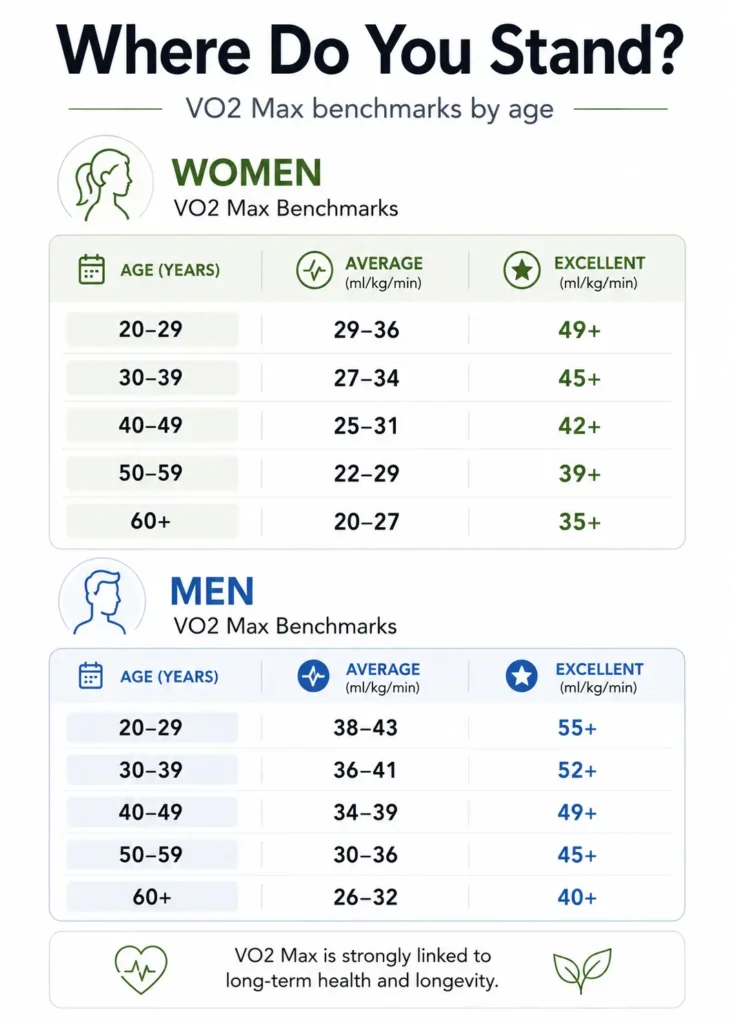
A simple breakdown of VO2 Max benchmarks for men and women. This chart shows where you stand by age, from ‘Average’ fitness to the ‘Excellent’ levels linked to a longer, healthier life.
Simply put, VO2 Max is the maximum volume (V) of oxygen (O2) in milliliters that your body can use per kilogram of weight in a single minute. That’s it. Obviously, higher numbers are better; if one person has a VO2 Max of 30, and the other has one of 60, the latter is clearly in better cardiovascular shape.
At this point, it would seem natural, even expected, to talk about the details of what’s going on in your body when it comes to VO2 Max, and what you can do to increase it. But I feel like I already talk about the science quite a bit in articles like this. We’ll definitely touch on how we can improve our numbers, but I’d like to focus on something else, the why VO2 Max is so important. To do that though, we’ll need to pivot a bit.
Let’s talk about doctors.
Medicine 2.0 vs 3.0
Western medicine is very much about reacting to things as opposed to being proactive; we’re very much about treating symptoms as opposed to proactively preventing the underlying causes of those symptoms. And, as a result, our doctors prescribe things like statins and blood pressure medications to keep us alive and keep our test numbers looking good.
An unfortunate byproduct of this is that many of us wind up fearing a loss of independence more than we fear death.
I’m not saying western medicine is bad; it isn’t. It does an amazing job in a number of areas. For example, it handles acute care very well, dealing with issues like broken bones, heart attacks and strokes. But it does have its areas in which it can be improved.
In defense of your doctor, I’m sure they’d love to get more into proactive care, but the time just isn’t there. Office visits typically run from 15-20 minutes and doctors see over 20 patients each day. There simply aren’t enough hours in the day for doctors to provide the level of care that they’d like.
And then there are the insurance companies. I leave that one right there. Simply put, the system seems overloaded and a little broken at this point.
There is, however, a newer medical movement that is fixated on being proactive instead of reactive; fixing problems before they come up instead of automatically dispensing meds after those problems show themselves.
Enter Medicine 3.0
In 2023, a doctor named Peter Attia released a book called Outlive: The Science and Art of Longevity. In his book, he focuses on addressing the quality of our lives, being proactive as opposed to reactive.
He refers to this philosophy as Medicine 3.0, and he details the need for things like genomic studies, full body scans, personal health coaching and more. His thinking is that, by taking the results of these tests, pairing us up with personal health coaches and working on personalized plans, we’ll become the healthiest versions of ourselves, thereby reducing the need for reactive treatments.
Sounds good, right? There’s a problem. It’s hugely expensive.
To see a Medicine 3.0 doctor, you’re probably going to need to sign up for a membership; it’s referred to as “Concierge Medicine” for a reason. Some memberships can be relatively inexpensive, starting off at around $400. But these starter plans are likely to include some very basic blood tests only. Or, you can sign up for a more all-inclusive plan. Expect to pay anywhere from $15,000 to $40,000 for that though, or more.
And that’s on top of the insurance premiums that you’re already paying.
More and more Medicine 3.0 clinics are popping up, so it is gaining traction but, at this point at least, it’s hardly something that’s accessible for most.
And I think it’s worth noting that Medicine 3.0 refers to conventional medicine as “Medicine 2.0” — that’s Attia’s label, not your doctor’s. Ask your doctor if they practice Medicine 2.0 and you’re likely to get the same kind of look that you’d get asking a cell phone salesperson about whether Google or Samsung made the better iPhone.
But why did I talk about Medicine 3.0 and how your doctor is currently treating you? Though both systems operate very differently, they agree on one thing: VO2 Max is one of the strongest predictors of mortality that we know of, rivaling and even exceeding other risk factors like coronary artery disease, smoking, diabetes, and more.
So, as it turns out, VO2 Max matters a lot more than just telling us how hard we can go and for how long.
Why does it matter so much?
VO2 Max: The Ultimate Stress Test
VO2 Max is the ultimate stress test for our bodies. It isn’t just a measurement of our lungs, it shows what’s happening throughout our entire system. Lungs must pull oxygen and expel CO2. To make this possible, the heart needs to be able to pump blood strongly and efficiently; blood vessels need to be able to transport it; mitochondria must be able to use that oxygen and other nutrients to fuel our muscles and organs. VO2 Max is very much an indicator of how effectively our body’s vital parts are functioning together and a highly important factor when it comes to all-cause mortality, which is a fancy way of saying, “all of the different ways that you can die”. In fact, the American Heart Association officially recommends treating VO2 Max as a “clinical vital sign”, right up there with blood pressure. So, it’s very much the case that every group in the medical community agrees on this.
Circling back to my niece’s curiosity about our comparative VO2 Maxes. I honestly thought that I’d be fine, that mine would be better than hers. Turns out, I may be wrong about that.
As a runner, I mainly lace up, head out and do as many easy miles as my schedule allows. And that’s clearly a good thing, but it doesn’t provide the bump in VO2 Max that I would have expected.
VO2 Max is best improved by doing things like HIIT; raising your heart rate to 90-95% max sustained effort for a few minutes — some people say 3-5 minutes, others will say 4-8, allowing the heart to recover, and doing it again. But, the type of running that I do, which is mainly slow and easy, absolutely has some serious benefits for building VO2 Max.
Why Zone 2 Still Matters
A lot of what happens as we start to run is that our bodies gradually increase the density of our capillaries in muscles, and increase the quality and number of our mitochondria. Remember that “VO2 Max is the ultimate stress test for our bodies” statement? All of these things that slower, zone 2’ish running, do for our bodies provides a fantastic base for improving VO2 Max. It’s like starting a home improvement project when three quarters of the work is already done.
What that means for me, and you if you’re in my position, is that, just by adding intervals to my routine, I’d likely see a significant bump in my VO2 Max relatively quickly. And, as well as improving my 5k and half marathon times, it’d reduce my “all of the different ways that you can die” chances.
Obviously, not all of us routinely run or go to the gym. Turns out, that for those of us who choose a bit more of a “comfortable” life, even getting out and doing something can yield significant benefits. In several large studies, those who go from doing nothing to doing something saw (depending on the study) a 10-15% drop in those “all of the different ways that you can die” numbers. And, while that seems like an obvious conclusion, that some exercise is better than none, we now have the data to back that up, and that data ties it directly to VO2 Max.
Comfortable or Resistant to Change?
Thinking back to the Trader Joe’s woman? It’s likely the case that we’re more alike than I’d care to admit — she has her checkbook and I have my 3-3 breathing rhythms as I wear my old-school runner badge of honor. Both of us have our routines, and we’re comfortable in them because they’ve served us well.
But there’s a big difference between being comfortable and being resistant to change.
I haven’t bought a Garmin yet, and I’m not sure that I will, the main reason being that I don’t wear watches, I hate having them on my wrist. But I’d be lying if I said that I wasn’t thinking about VO2 Max now in a way that I never have. Until recently, I thought that it was all about being able to run harder, being able to push the limits of what our bodies can handle. And as most of my runs are long and slow, it’s never been a huge priority for me. Knowing what I know now though, I’m rethinking things.
I still pay cash when I can and that’s not going to change any time soon so that early stage Luddite mentality is definitely there. I’m not trading my cash for a digital wallet just yet, but perhaps running is one area in which I can officially join 2026?
Sources & Further Reading
- Primary Care Doctors Need 24+ Hours a Day – A sobering look at why your doctor is rushed and the systemic time constraints on proactive care. (via UChicago Medicine)
- Fitness as a Clinical Vital Sign – The official scientific statement making the case that VO2 Max is as important as blood pressure. (via American Heart Association)
- Cardiorespiratory Fitness and Long-term Mortality – The data behind why being “fit” is one of the strongest predictors of a long life. (via JAMA Network)
- What is Medicine 2.0? – A breakdown of the shift from reactive symptom-treating to the proactive future of healthcare. (via MaRS Discovery District)
- Outlive: The Science and Art of Longevity – The foundational text by Peter Attia, MD, that defines the Medicine 3.0 philosophy. (via Amazon)