Why We Overeat
Have you ever put away half a bag of chips after intending to eat just a few? How about being that person who dives nonstop into hors d’oeuvres at a Super Bowl party? Most of us have been there. We sit down intending to just eat a little bit of whatever and, before we know it, we’ve eaten way more than we’ve planned.
Why do we do this and, more importantly, how do we stop? Let’s first look at the why.
As we continue, keep in mind that the science is still very much evolving on this issue. As much as we want a clear answer on why we overeat—why we keep eating chips and cookies instead of just stopping at one or two — we’re just not at that point yet. But, we do know enough to say that it’s likely tied to multiple issues; how our brains are wired, our environment and our individual differences.
Why We’re Drawn to High-Calorie Foods
We, as humans, have been around for a long time and early in our existence, obtaining calories was a huge deal. As hunter-gatherers, things like fruits and berries provided energy, but they’re relatively low in calories and tend to be seasonal. Foods that were higher in calories gave our bodies more bang for the buck; they gave us more of what our bodies actually needed.
And this is one reason why we’ve developed such an attraction to foods that are more calorie dense. A successful hunt could bring a tremendous amount of calories and could help us navigate through times when calories brought in through gathering were scarce. So, in an environment when our next meal wasn’t guaranteed, being able to bring home a bison, elk or boar was gold.
The problem is, that environment changed.
Today, those calorie dense foods are everywhere. We have apps like DoorDash on our phones that can have a pizza on our doorstep relatively quickly, and every major grocery store has multiple aisles dedicated to cookies and crackers, chips and soda. Hunter-gatherer has been replaced by drive-grab and tap-wait.
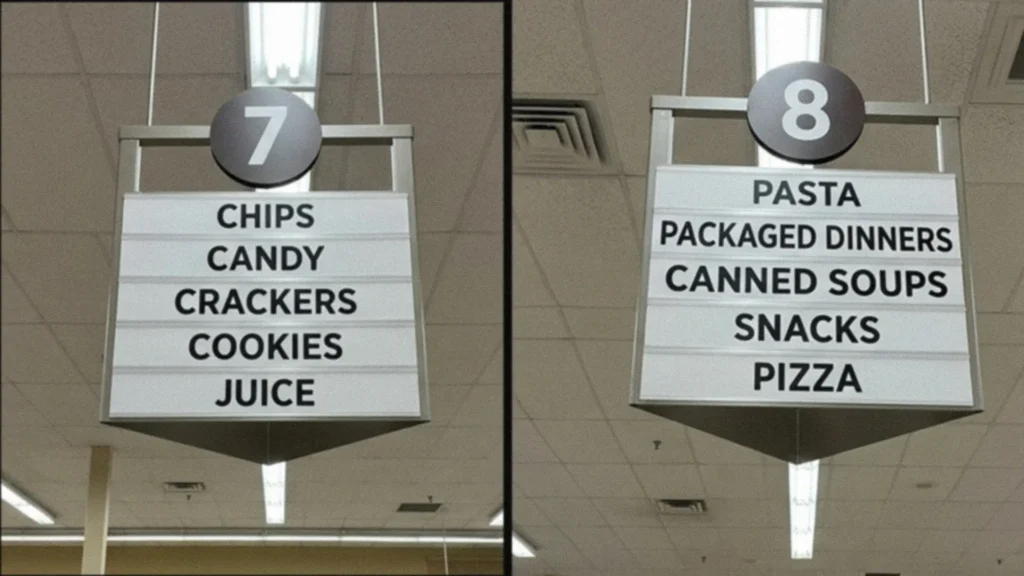
Our brains developed in a world where meals weren’t a guarantee. Today, however, multiple aisle in stores are devoted to highly processed and unhealthy foods.
To make matters worse, the science seems to suggest that our brains aren’t really all that good when it comes to choosing how beneficial these calories are for us. Once we see something that has a lot of calories — pizza rolls for example — our brains don’t naturally steer us towards more nutritious options, we’re just interested in finding energy. So, when we see that plate of pizza rolls, our brain thinks “Energy!”, without fully considering exactly how many calories we’re actually consuming. In short, our brain seems much better at recognizing that food is valuable and vital than it is at accurately judging the actual amount of calories that we’re consuming.
So what we have now is very much a perfect storm relationship with food — an innate drive towards high calorie foods and incredible ease in finding them, and a brain that’s more interested in calories than how well our pants fit the next day.
Why Some People Struggle More Than Others
But all of this begs a question, in my mind at least. If this is how our brains work, why doesn’t everyone down a third of a bag of chips? Why can some people stop at one or two and other’s can’t?
It’s been found that not everybody receives the same “reward” by eating food; some people seem to find it more rewarding than others. And if this seems a bit confusing, I’ll try to clear it up but here’s a tip: it appears to involve dopamine.
The Dope on Dopamine
Dopamine is often misunderstood; we tend to think of it as that thing that gives us pleasure, like there’s a magic elixir that our bodies produce to give us some sort of euphoric high when we have a cool experience. It doesn’t work like that though.
Without getting too nerdy, dopamine is a response. When we do something that we enjoy or we know is good for us, dopamine comes in and says, “Hey, that was a cool thing, let’s do it again!”. It’s a thing that reinforces, that motivates us to repeat what brings us pleasure. And, for some, this process plays a more dominant role than others when we eat something like a pizza roll; for a select few of us, we perceive eating that pizza roll as more rewarding and we’re motivated to do it again.
So we have this perfect storm that’s formed — a brain that’s wired to seek out calorie-dense foods, one that values energy over amount of calories, a system that actually rewards us and motivates us to eat more, and an near-infinite array of easily attainable high-caloric options. Awesome.
Can Exercise Change What We Want to Eat?
So what do we do with all of this; how does it help us stop eating pizza rolls? Short answer, it doesn’t. While we can’t change the internal wiring of our brains, we can do a few things that tilt the odds a bit in our favor. One way is through exercise.
Sure, exercise burns calories, this isn’t new information. But, evidence suggests that it may have a second effect: it can impact our dietary choices. And I’ve seen this play out in my life.
I’m a runner and, in those periods when I’m running, I find it much easier to make good dietary choices. My go-to’s are fruit/veggie smoothies (heavy on the veggies), supplemented with things like turkey breast sandwiches on whole grain bread. When I take a few weeks off though, I’m much more likely to grab some ice cream on the way home at night or throw some cheese on my turkey sandwich.
And science seems to support what’s going on. Though we aren’t yet able to fully understand the mechanics of what’s happening, several studies have noted that physically active people may experience a shift away from typical snack foods and more towards a healthy diet. And I use the word, “may” because that’s how science works — until we can scientifically prove something, things remain a “may”. But there is a great deal of consistency that has been noted in these studies, and I’ve experienced it myself.
Why Willpower Usually Fails
As effective as exercise is though, there’s one thing that it’ll never be able to defeat: our surroundings.
If you’ve made it this far, you’ve probably noticed a recurring theme: our bodies are attracted to calorie-dense foods. Extending that idea, when we’re presented with a spread of cookies, chips, apple slices and carrots, there’s going to be stronger pull towards the cookies and chips — we’re probably not going to opt for the healthiest option.
We could rely on willpower in these types of situations, but we’ve already proven that doesn’t work. And by the way, science sees this as a poor option as well, going so far as to call it “a fraught concept.”
Changing the Environment Around Us
The simple answer? Control what’s around us.
And this is the part where we leave much of the science behind and go into what’s worked for me. And here’s a tip: you may not like these solutions but, if you’re desperate, they may be worth considering.
If you’re the kind of person who downs a third of a bag of Doritos after telling yourself that you’ll just have a few? Leave the bag of Doritos at the store. If you think about it, Doritos, or just about any other snack food for that matter, provide next to zero benefit for us beyond those calories that our hunter-gatherer ancestors valued so much. In fact, they’re very much bad for us. This isn’t new information; leave them at the store.
And, if you find yourself regularly attending birthday parties, work gatherings or family get togethers where you know that there’s going to be foods that cause you to struggle? Show up later when the food options will be more limited. I’ll actually go as far as to call and say something like, “Text me after the cake has been put away.” Does that sound a bit on the militant side and is it less fun? Absolutely. But it saves me from gorging and feeling like doggie excrement later that night and the next day countless times.
And, while we’re on the subject, and I’ve put on my dietary militant hat, there’s no rule that says that you need to eat with everyone else. Restaurants can present a myriad of issues for those of us who struggle to stick to healthy options; those select few of us who gets those dopamine signals to go for the bottomless plate of fries. At least that’s certainly the case for me. So, don’t go, circle up with friends later. And, if it’s family meals that cause you to struggle, separate yourself from the situation and make a smoothie or a quinoa salad.
Of course, this brings up the obvious situation of what others are going to think. Know this: there’s an excellent chance that they won’t get it, that they won’t understand. That’s ok though, they don’t need to, it’s not their life.
My advice? Exercise, start running or go to the gym. Not only will you burn calories, but there’s every chance that your food preferences will change. And control what’s around you, however you need to do that. I’ve told you how I do it, but that doesn’t mean that there aren’t better and more creative solutions out there. Get creative.
Again, this is an issue that isn’t easily solved. If it was, there wouldn’t be so much science happening trying to figure it out. But the fact remains: it is an issue. In the same breath though, there are few things that I genuinely find more satisfying than grabbing my smoothie at the end of the day, laying on the couch and turning on the TV before going to sleep. It’s genuinely relaxing, it’s that book-end that closes the chapter on the day and it’s a low-cal, nutrient-rich way to put the day’s issues behind me.
Sources & Further Reading:
- Physical Activity Protects Against Dietary Lapses: The Drexel Study – An objective analysis tracking how physical activity serves as a behavioral defense mechanism against overeating and helps regulate appetite control. (via PubMed Central)
- Undervalued and ignored: Are humans poorly adapted to energy-dense foods? – An evolutionary biology perspective on how the human brain is hardwired to seek out energy-dense options but struggles to accurately gauge modern caloric abundance. (via ScienceDirect)
- Expert insight: How exercise can curb your junk food craving – A breakdown of the neurological mechanisms that occur when working out, showing how physical activity naturally alters food preferences away from snacks. (via Western News)
- The Influence of 15-week Exercise Training on Dietary Patterns among Young Adults – Real-world study data demonstrating a consistent shift toward healthier whole-food dietary patterns when individuals introduce regular exercise into their routines. (via PubMed Central)
- Food Reinforcement, the Dopamine D2 Receptor Genotype, and Energy Intake – Scientific research exploring why certain individuals experience a significantly higher neurological “reward” and dopamine response from high-calorie foods than others. (via American Psychological Association)
- The Self-Control Of Eating – A psychological deep dive evaluating human behavior around food environments and outlining why relying on raw willpower is a fundamentally flawed concept. (via Swarthmore College)